Stay Awesome

Understanding the Proposals to Amend Vaccination Regulations.
March 2026

At first glance, the document is quite difficult to navigate. Much of the text refers to specific regulation numbers rather than explaining the practical implications, which can make it challenging for those working in primary care to understand what might actually change. In reality, the proposals are largely about making permanent some of the regulatory flexibilities introduced during the COVID-19 vaccination programme, allowing vaccination services to remain agile and scalable in the future. For those working in general practice and other primary care settings, the proposals are less about changing the clinical practice of vaccination and more about how vaccination services can be organised, staffed and supplied. Below is a simple summary if you are having the same difficulty that I did with ploughing through it.
The broader context
During the COVID-19 pandemic, the UK introduced several temporary regulatory changes to allow vaccination programmes to be delivered rapidly at scale. These included expanding the vaccination workforce, allowing vaccines to be prepared by trained support staff, enabling off-site vaccination clinics, and simplifying the movement of vaccine stock between providers. These measures were designed for emergency use, but many proved operationally useful beyond the pandemic. The current proposals therefore aim to retain some of these mechanisms within the Human Medicines Regulations, so that vaccination programmes can continue to be delivered flexibly when required.
Expansion of the vaccination workforce - Regulation 247A
One of the most significant elements relates to Regulation 247A, which was introduced during the COVID-19 programme. This regulation allows vaccines to be administered under a national protocol, rather than requiring an individual prescription or a patient group direction (PGD).
National protocols differ from PGDs in that they allow different parts of the vaccination process to be carried out by different members of the team. For example, one person may prepare the vaccine, another may administer it, and another may provide supervision. This model made it possible to involve a wider workforce during mass vaccination campaigns.
The proposal removes the restriction that this regulation can only be used during a pandemic. In practical terms, this means that national protocols may continue to be used for certain vaccination programmes in the future, particularly where rapid or large-scale delivery is required.
For general practice, this does not necessarily mean a sudden change in who vaccinates, as most routine programmes still operate under PGDs or patient-specific directions. However, it does mean that future vaccination campaigns could continue to involve a broader workforce operating under national protocols.
Vaccine preparation by trained staff - Regulation 3A
Another proposal relates to Regulation 3A, which allows trained staff to prepare and assemble vaccines for administration without requiring a manufacturer’s licence. This provision was introduced to support large vaccination centres where vaccines needed to be drawn up in advance by trained personnel. In practice, many vaccination services already operate in this way. The proposed amendment simply ensures that this approach can continue where appropriate, provided staff are appropriately trained and supervised.
Movement of vaccine stock between providers - Regulation 19
The proposals also address Regulation 19, which concerns the movement of medicines between organisations. Under normal circumstances, transferring medicines between providers can require a wholesale dealer licence. During the pandemic, temporary provisions allowed vaccines to be redistributed more easily between NHS providers. Making this change permanent means that vaccines may continue to be shared between providers within the NHS system, helping to reduce wastage and allowing stock to be moved quickly when needed.
Vaccination outside traditional premises - Regulation 233(8)
Another area covered by the proposals relates to the ability to administer vaccines away from registered premises under a PGD. This flexibility proved essential during the pandemic when vaccination clinics were delivered in a wide range of settings, including community centres, care homes and temporary clinics.
The proposals support continued flexibility in where vaccines can be delivered. For primary care teams, this reinforces the ability to run community clinics, outreach sessions and vaccination events outside the traditional surgery setting.
Occupational health vaccination (Schedule 17)
The consultation also addresses vaccination within occupational health settings, ensuring that occupational health providers can continue to administer vaccines under appropriate medical direction. This helps support workplace vaccination programmes, including those for healthcare workers and other high-risk groups.
What this does – and does not – change
Importantly, these proposals focus on the regulatory framework that enables vaccination delivery, rather than altering clinical guidance or training requirements. They do not replace professional standards such as the National Minimum Standards and Core Curriculum for Immunisation Training, nor do they change the expectation that vaccinators must be appropriately trained and competent. In other words, while the regulations may provide more flexibility in how vaccination services are organised, the fundamental requirements for safe practice, training and governance remain unchanged.
Why this matters for primary care
For many general practice teams, the immediate impact of these proposals may feel limited. Routine vaccination programmes will continue to rely heavily on established mechanisms such as PGDs and patient-specific directions.
However, the proposals do signal an important shift in how vaccination programmes may be delivered in the future. The experience of the COVID-19 campaign demonstrated that vaccination services sometimes need to operate at scale and with speed. Retaining regulatory mechanisms that allow workforce flexibility, mobile clinics and efficient stock management helps ensure that the system is prepared for future public health challenges.
For clinicians working in immunisation and travel health, the key takeaway is that the legal framework supporting vaccination delivery is evolving, but the core principles of safe vaccination practice remain firmly in place.
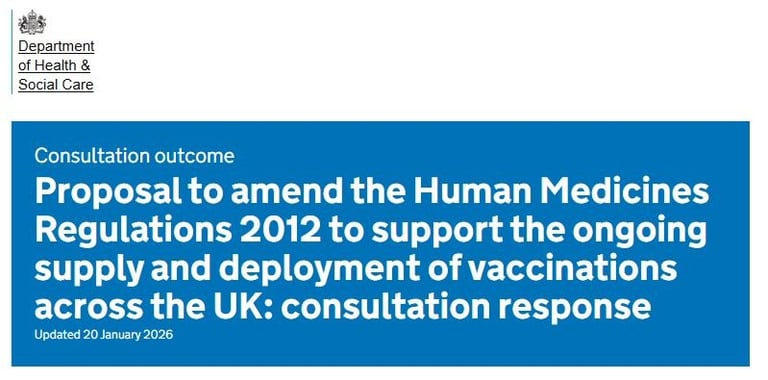
Earlier this year, the UK Government published a consultation response outlining proposed amendments to the Human Medicines Regulations 2012 to support the continued supply and delivery of vaccination programmes across the UK.