Stay Awesome

Hepatitis A
Find most of the information you need in these resources
Always refer to your local signed PGD's in practice, and remember the Green Book takes priority over the SPmC - and sometimes WHO takes priority over the Green Book! They don't always say the same!







Keeping up to date: Things to know in practice currently:
22nd Oct 2026: UKHSA’s immunoglobulin handbook, providing guidance on administering immunoglobulin to prevent serious disease, has been updated to reflect a change in human normal immunoglobulin (HNIG) product procured and issued by UKHSA for post exposure prophylaxis against hepatitis A in the community.
1st October 2026: Hepatitis A/B vaccine: patient group direction template updated - removal of chronic hepatitis B from the inclusion criteria because giving hepatitis B in such circumstances is futile and monovalent hepatitis A vaccine would be more appropriate. The hepatitis A PGD template has also been updated just with some minor rewording, layout and formatting changes for clarity and consistency with other UKHSA PGD templates
2nd Feb 2026: Hepatitis A infection: prevention and control guidance (pictured below) updated with some translated materials. This is important guidance to help public health professionals manage hepatitis A infections and recommendations for pre-exposure immunisation.
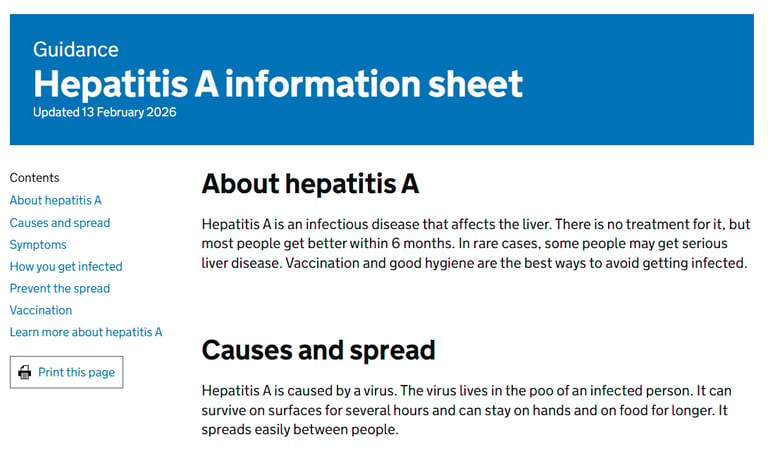
15th Dec 2025: Further to last: It's worth having a good browse through the updated hepatitis A information for the public - check out the posters and information sheet...
12th Dec 2025: Hepatitis A infection: prevention and control guidance updated (updated information sheet). This is guidance to help public health professionals manage hepatitis A infections and recommendations for pre-exposure immunisation.
13th May 2025: A timely reminder about the importance of hepatitis A vaccines and being careful with food and drink while away, even in seemingly 'low risk' places. In 2022, there were 4,548 cases reported across 30 European countries. Hepatitis A is spreading rapidly in the Czech Republic with 6 deaths so far. The country recorded 450 cases and six deaths from hepatitis A in the first four months of 2025, compared with 636 cases and two deaths all of last year.
JAN 2024 Green book chapter updated. Updated details on human normal immunoglobulin (HNIG) administration and Sanofi Pasteur's contact information
APRIL 2023 New UK-licenced vaccine! Sanofi released Avaxim Junior for the kiddos. Always nice to have more options.
My traveller missed their second hepatitis A dose. Do I need to restart the course?
No. The hepatitis A course does not need to be restarted, even if the second dose is several years late. The recommended interval for the second dose of monovalent hepatitis A vaccine is 6–12 months, because this provides continuous long-term protection. However, immune memory from the first dose persists and studies have shown a successful boosting response even when the second dose is given years later. So, for example, if a traveller received their first dose seven years ago, give the outstanding second dose rather than starting the course again.
Does my traveller need a hepatitis A booster after 25 years?
Not automatically – but many travellers may meet the criteria for one. Current Green Book guidance says that a booster 25 years after a completed course is generally not required unless the person remains at ongoing risk of hepatitis A. In travel medicine, a person travelling again to a country where hepatitis A vaccination is recommended can reasonably be considered to have an ongoing risk at that point. Therefore, if their completed course was around 25 years ago and they are travelling again to a hepatitis A risk area, a booster would currently be recommended.
This does not mean routinely recalling everybody at 25 years simply because the date has arrived. The booster is linked to continued or renewed risk. The evidence on duration of protection is reassuring and protection may last considerably longer than 25 years, but current UK guidance remains to offer a booster at 25 years where ongoing risk exists.
What should I do if another 25 years have passed since the 25-year booster?
At present, there is no recommendation for automatic hepatitis A boosters every 25 years. The Green Book gives advice about a booster 25 years after the original completed course for those who remain at risk, but it does not currently describe a repeating 25-year booster programme. If a traveller reaches that point in the future and remains at risk, check the guidance current at that time rather than automatically administering another dose.
My patient had a paediatric hepatitis A dose as a child but is now an adult. Do I need to restart the course?
No. The previous valid dose still counts. If they received an age-appropriate licensed hepatitis A vaccine as a child, there is no need to restart simply because they are now an adult. Complete the course using a vaccine and dose appropriate for their current age. For example, somebody who received a paediatric hepatitis A vaccine as a child but is now an adult should receive the appropriate adult preparation for their outstanding dose.
Can I mix Twinrix with monovalent hepatitis A vaccine?
Ideally, avoid mixing schedules unless there is a clear reason and appropriate guidance to support what you are doing. Twinrix Adult contains less hepatitis A antigen per dose than adult monovalent hepatitis A vaccines and uses a three-dose primary schedule, whereas the usual monovalent hepatitis A course uses two doses. The Twinrix product information therefore advises completing an initiated primary course using the same vaccine.
This is different from changing between licensed monovalent hepatitis A vaccines, which may be used interchangeably. If a traveller has already received a mixed or unusual schedule, look carefully at exactly which products, doses and intervals were given and seek appropriate guidance rather than automatically restarting the course.
Can I give Twinrix on the NHS when hepatitis A is indicated for travel?
Hepatitis A vaccination for an indicated traveller is available on the NHS, whereas hepatitis B vaccination solely for travel is normally private. However, where hepatitis A is NHS-indicated and a combined hepatitis A/B vaccine such as Twinrix is used, the patient should not be charged simply because the chosen vaccine also provides hepatitis B protection. A practice may make a local decision not to stock or routinely use Twinrix, for example because of cost. That is different from saying that Twinrix must be charged for if it is used to provide an NHS-indicated hepatitis A vaccination.
Local commissioning arrangements, PGDs/PSDs and organisational medicines policies should always be followed.
My traveller is leaving tomorrow. Is it too late to give hepatitis A vaccine?
No. Give it.
Ideally, hepatitis A vaccine should be given at least two weeks before travel, but the Green Book states that it can be given up to the day of departure. Antibodies may not yet be detectable for around 12–15 days after a monovalent dose, but some protection may develop before measurable antibody appears. A late presentation should therefore not be used as a reason to withhold hepatitis A vaccination.
Can I give hepatitis A vaccine to a pregnant traveller?
Yes, when clinically indicated. Hepatitis A vaccines are inactivated vaccines and do not contain live virus. The Green Book states that hepatitis A-containing vaccines may be given during pregnancy when indicated. There is no evidence of risk from administering inactivated viral or bacterial vaccines during pregnancy or breastfeeding.
As always in travel health, the decision should follow an individual risk assessment considering the destination, likelihood of exposure and potential consequences of infection.
Can I give hepatitis A vaccine at the same appointment as other vaccines?
Yes. Hepatitis A-containing vaccines can be administered at the same visit as other vaccines, including hepatitis B, MMR, MenACWY, Td/IPV and other travel vaccines. They should be administered at separate sites, preferably in different limbs. If two injections have to be given in the same limb, they should be separated by at least 2.5 cm, and the site of each vaccine should be recorded.
Do I need to check hepatitis A antibody levels after vaccination?
Not routinely in an immunocompetent traveller. Hepatitis A vaccines are highly immunogenic and routine post-vaccination antibody testing is not generally necessary following an appropriately completed course.
There may be situations where antibody testing or specialist advice is appropriate, particularly in people with altered immune responses, because seroconversion rates and antibody titres may be lower. Testing also has specific roles in the public-health management of hepatitis A exposure, but this is different from routinely checking whether a healthy traveller has responded to vaccination.
My traveller says they have previously had hepatitis A. Do they still need vaccination?
If there is reliable evidence of previous hepatitis A infection, vaccination is not normally necessary because natural infection produces immunity. A documented previous positive anti-HAV IgG result or laboratory-confirmed hepatitis A can provide evidence of previous infection. Where the history is uncertain, vaccination is generally safe even if somebody is already immune, so vaccination should not necessarily be delayed purely to arrange serology unless there is a particular reason to test.
Can I vaccinate someone who is mildly unwell?
Usually, yes. A minor illness without significant systemic upset is not a reason to postpone hepatitis A vaccination. If somebody is significantly acutely unwell with a fever, vaccination may be delayed until they have recovered. This is mainly so that symptoms of the illness are not confused with vaccine adverse effects, rather than because the vaccine is unsafe or unlikely to work.
How long can I consider my traveller protected after one dose of hepatitis A vaccine?
A single dose of monovalent hepatitis A vaccine provides protection for at least 12 months, probably longer. But for long-term protection, a second dose should normally be given 6–12 months later. That second dose produces a substantial boosting response and provides protection for at least 25 years.
Bits and bobs to casually drop into conversation
Did you know....
According to Travel Health Pro and the CDC
Each year there are an estimated 1.4 million cases globally
Hepatitis A is among the most common of the vaccine-preventable infections acquired during travel
The likelihood of having symptoms with Hepatitis A infection is related to the age of the infected person. In children aged <6 years, most (70%) infections are asymptomatic; jaundice is uncommon in symptomatic young children.
Among older children and adults, the illness usually lasts <2 months, but ≈10%–15% of infected people have prolonged or relapsing symptoms over 6–9 months.
During 2019 there were 503 confirmed laboratory reports of hepatitis A infection in England and Wales