Stay Awesome

Meningococcal Disease
Find most of the information you need in these resources
Always refer to your local signed PGD's in practice, and remember the Green Book takes priority over the SPmC - and sometimes WHO takes priority over the Green Book! They don't always say the same!




FOR THE GONORRHOEA MENB VACCINE PROGRAMME INFO PLEASE GO TO THE GONORRHOEA PORTAL
Recent Updates & News
22nd Sept 2026: UKHSA and University of Oxford scientists uncover genetic changes in the bacteria causing severe Kent meningococcal disease outbreak
As of the end of July, almost 90,000 young people had received their first dose of the meningitis B vaccine, as part of the catch-up vaccine campaign. A further 135,000 bookings have been made for the first dose, to take place in the next weeks. NHS England has more details on this.
10th Sept 2026: Invasive meningococcal disease in England: annual laboratory-confirmed reports for epidemiological year 2025 to 2026: 348 cases of IMD were confirmed from July 25 to June 26. MenB accounted for 88.8% (309 of 348) of all cases, followed by MenW (19, 5.5%), MenY (5, 1.4%), and MenC (2, 0.6%). 11 ungroupable cases were also reported. MenB was responsible for the majority of IMD cases in individuals under 25 years of age. The provisional IMD case fatality ratio (CFR) in England was 7.5% (26 of 348).
24th July: useful eligibility flow chart for the temporary MenB prog!
20th July: GOOD LUCK to those of you who are starting the MenB adolescent vaccines today. Here's a reminder of where you can find all the key guidance around this time-limited offer.
16th July 2026: Exciting prospects!! JCVI has published new recommendations for a routine adolescent MenB vaccination prog today. I've been waiting for this as I'm sure a lot of you have. The Department of Health and Social Care will consider the recommendation before a decision is made on any changes to the NHS MenB vaccination schedule but it looks promising for a menB routine vaccine for the teens! Read all about it here.
The recommendation is for one dose of the 4CMenB vaccine at around 15 years of age in those who were eligible for MenB vaccination in infancy (those born on or after 1 May 2015), also referred to as ‘primed adolescents’. The first cohort of individuals this recommendation would apply to would turn 15 years of age in 2030. Additionally, JCVI strongly supports an offer of two doses of MenB vaccine for:
adolescents born on or before 30 April 2015 (‘unprimed adolescents’) at around 15 years of age.
adolescents who would be either too young to be offered MenB vaccination as part of the one-off 2026 offer (announced 12 June 2026), or too old to be offered vaccination through the 15-year-old programmes outlined above (this would be a catch-up programme)
29th June 2026: More on the temporary immunisation for MenB: Links were added to gov.uk to an information for healthcare practitioners doc and training slides, booking information and PGD.
16th June: More info about the MenB implementation - find everything you need here. And the letter is here. Community pharmacies are commissioned under an advanced service specification. The limited PGD is also in situ now. The size of the eligible cohort of patients is estimated to be around 1 million people.
12th June 2026: GREAT MenB news (although I have to admit finding out about this on BBC news)!! Meningitis B vaccine to be offered to a million young people. While each nation has slightly different plans, the one-off MenB vaccination programme (2 doses 28d apart) will broadly be available to:
Most pupils completing Year 13 or S6 in the summer of 2026 - irrespective of their education plans. (Most children from this age group who are not currently in school will also be eligible.)
Young people aged 18-25 starting university or moving into residential further education settings for the first time in autumn 2026
All those who are eligible can continue to get first doses until 31 December 2026; they can get their second dose up to 31 March 2027.
UKHSA Press release (after the BBC announced it): Thousands of young people to be offered two-dose MenB vaccine and the Vaccine Knowledge Project website has been updated to reflect this welcome addition. There is also this blog which goes into details about eligibility and questions like 'why is the programme not being rolled out to all young people?'
14th May: Oh no!! another MenB death: Student dies and two people being treated after meningitis outbreak in Reading (not the same strain of MenB as Kent).
30th April 2026: Resources and information have been published relating to the UKHSA's investigation of the meningococcal bacteria carriage amongst the students aged 18 to 24 in Kent which will be taking place from May 2026.
April 2026: This month it's second MenB dose time for the eligible Kent students. It is important that everyone who had dose one is given their second dose from four weeks after the first. For those who were offered the MenB vaccine and have not yet received their first dose they remain eligible until 8 May. For students who have returned to university, they will be able to access their second dose at vaccination clinics which are arranged in the local area. For those students who have not returned to the university, they should access vaccination at their own GP practice.
25th March 2026: Kent meningitis outbreak prompts rush for routine vaccinations in England
23rd March 2026: Meningitis: Kent outbreak “passes peak” as one new suspected case is reported in northwest England (BMJ). More than 9300 young people have now received vaccinations as part of the targeted rollout, with more than 12 700 given preventive antibiotics. This is a pretty incredible effort, well done to those who got on it quickly.
21st March 2026: A meningitis B training slide set for healthcare professionals delivering vaccinations is available to download.
20th March 2026: MenB strain may have evolved to be more transmissible (BMJ)
19th March 2026: Meningococcal disease outbreak resources for those in areas affected by the outbreak: resources to support the meningococcal outbreak response. The Health Secretary says he’s making 20 thousand more vaccines available and vaccination has been extended to everyone who has been offered preventative antibiotic treatment as part of this outbreak..
Look out for contacts all across the UK (students are heading home and that could be ANYWHERE): All GP surgeries can offer MenB vaccine to certain groups. At the present time, this includes:
Students at the University of Kent who are normally resident on the Canterbury Campus, including those who may have now travelled home. Some staff living or working in these Halls of Residence have also been offered antibiotic prophylaxis.
Students in relevant halls of residence or other private dwellings who attend other universities in Canterbury and have been advised to take an antibiotic due to a close contact.
Individuals who attended Club Chemistry from 5 March until it closed voluntarily on March 16.
This list may be added to in the coming days as further information emerges.
Sixth form or other year groups and education settings in Kent where there are confirmed or probable cases are also eligible and have been notified by schools or UKHSA. Local arrangements are in place to offer vaccination to this group. Anyone in an eligible groups who presents can be vaccinated across the country. UKHSA are asking that an offer is in place by no later than Monday 23 March, if not sooner.
18th March 2026: Outbreak of invasive meningococcal disease, South East England: This alert outlines recommended courses of action to manage cases with infection and contacts. Also take a look at this: Meningitis B outbreak: what you need to know. AND here is the inevitable letter to ICBs.
18th March 2026: New vaccine to stop deadly meningitis epidemics confirmed to be safe (in Africa - ACWYX vaccine)
17th March 2026: Meningitis outbreak in Canterbury and east Kent: The Secretary of State Wes Streeting updated the House of Commons on the meningitis outbreak and the latest steps being taken to support those affected.
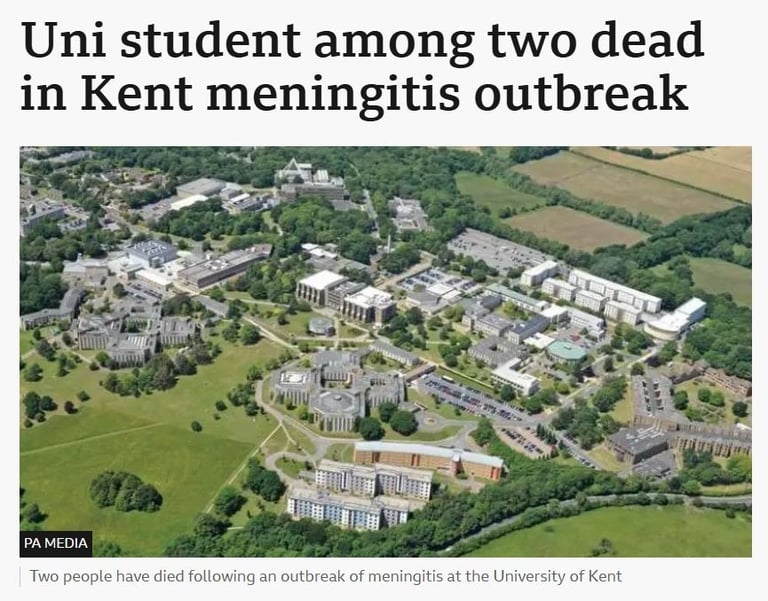
15th March 2026: Mega sad :-( Two die in university meningitis outbreak - not sure which strain yet *Update - it's Menb*. But if it's a vaccine-preventable one it makes it all the more tragic (*Update : turns out it is*). Keep an eye on live updates here. Could we be anticipating a vaccine catch up? (Update: Targeted locally, yes, alongside prophylactic ABX) UKHSA is on it... let's await further news. MenB for adolescents has been discussed for a while now. Those poor students :-( so sad. Here's some more from UKHSA: Latest updates from the ongoing outbreak.
29th Jan 2026: Uptake data! The MenACWY vaccine coverage data is here for 23-24. Year 9 student uptake was lowest in the North West (66.5%) and highest in the South East (78.5%). MenACWY coverage in year 10 students was lowest in London (64.9%) and highest in the East of England (83.0%).
1st Dec 2025: This somber article is about Men B. Will this one day be on the adolescent schedule? Keep an eye on ABCWY vaccine progress... Our daughter died from meningitis after starting uni - a jab would have saved her
27th Nov 2025: Country Information updates have happened on Travel Health Pro in relation to meningococcal disease
13th Nov 2025: Surveillance data! 378 cases of invasive meningococcal disease (IMD) were confirmed in 2024-25. MenB accounted for 82.6% (313 of 378) of all cases, followed by MenW (43, 11.3%), MenY (13, 3.4%), and MenC (9, 0.8%). UKHSA reported five cases of Meningococcal W between February and March 2025. Men B cases are on the rise.
31st October 2025: Vaccination crucial as meningitis cases increase
27th August 2025: Updates to the meningococcal C immunisation programme page: updated Information for HCPs and slidesets to account for removal of men C vaccine in infancy and to change some of the branding to UKHSA instead of PHE.
11th August 2025: MenB information for healthcare practitioners for infants updated to add guidance on incorrect intervals between doses.
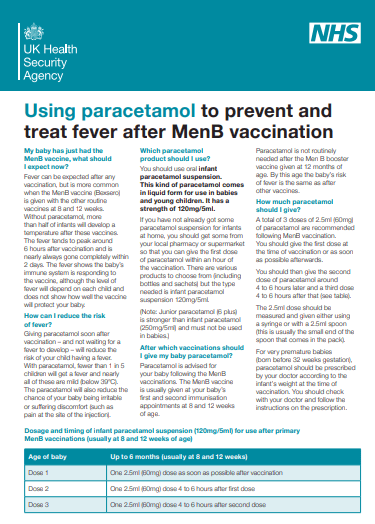
23rd June 2025: Information updated about the meningococcal B (MenB) vaccine and paracetamol use. Updated to reflect the change in timing of MenB doses to 8 and 12 weeks of age in line with the changes to the routine childhood immunisation programme from 1 July 2025
12th June 2025: a new Green Book chapter for meningococcal has been published alongside the current one in anticipation of next month.
9th June 2025: Meningococcal B: vaccine information for healthcare professionals updated today.
6th June 2025: MenACWY programme: information for healthcare professionals updated along with a fresh new set of slides (also linked above). The MenB equivalent has also been updated today to align with the changes to the childhood immunisation schedule from 1 July 2025, moving second MenB dose to 12 weeks from 16 weeks.
5th June 2025: PGD template updates: Hib/MenC, MenACWY risk groups, MenB, and MenACWY.
30th April 2025: A BIG update came along today - the 'changes to the routine childhood schedule letter'. Big read with lots of changes to absorb. I won't repeat it all here but do have a good read.... some of this relates to MenC and MenB on the childhood prog. (see UKHSA webinar link on news page in June and consider registering for more info). Expect Green Book updates, PGD changes and perhaps a small amount of chaos while we adapt to the changes. Keep calm and keep the kettle on....
24th April 2025: Meningitis is certainly in the spotlight for pilgrims lately. This news item appeared today: UKHSA urges Hajj and Umrah pilgrims to get meningitis vaccination. UKHSA has confirmed 5 cases of MenW disease between February and March 2025 in people who had recently returned from KSA or in their close contacts in England and Wales.
11 April 2025: The WHO highlighted 17 confirmed cases from multiple countries of invasive meningococcal disease linked with travel to Saudi Arabia for religious pilgrimages. Initial reports from the KSA highlighted 11 cases in unvaccinated pilgrims who performed Umrah in the KSA between 7 January and 18 March 2025. A further six cases were reported to the WHO in pilgrims recently returned from Umrah, with two of the six confirmed as serogroup W. NaTHNaC have reported on this here. Quite shocking to learn that As of 10 March 2025, the KSA authorities estimate that only 54% of international Umrah pilgrims had complied with meningococcal vaccination requirements.
31st March 2025: Meningococcal disease: guidance, data and analysis: updated! Lab case data from July to September 24 are published too (as of 27th march). Following the complete withdrawal of COVID-19 containment measures in England from July 2021, overall case numbers returned to pre-pandemic levels driven mainly by group B meningococcal disease. Cases due to the other capsular groups remained very low because of the highly effective indirect (herd) protection provided by the adolescent meningococcal ACWY vaccine programme introduced from August 2015, alongside direct protection in those vaccinated. The distribution of meningococcal cases by capsular group causing invasive meningococcal disease (IMD) between July and September 2024 is summarised in a table in the document but worth noting that Men B accounted for 85.4% of all cases (41 of 48), followed by MenW: 6.3% (3 cases), MenY: 2.1% (1 case), MenC: 2.1% (1 case) and MenE: 2.1% (1 case). There were no confirmed cases for any other capsular groups. There were 41 Men B cases confirmed between July and September 2024, compared to 45 cases in the corresponding period in 2023. Between July and September, Men B was responsible for 93.3% (28 of 30) of IMD cases in individuals under 25 years of age and 72.2% (13 of 18) of cases in individuals aged 25 years or older. All confirmed cases of MenW, MenY and MenC occurred in individuals aged over 25 years. The one case of MenE was aged between 5 and 9 years.
13th March 2025: Meningococcal B: vaccine information for healthcare professionals doc updated. The PDF version of this guidance has been replaced by an HTML version. The title has been changed to clearly distinguish this guidance from that for other programmes. The guidance includes updated epidemiological information, and the references to latex and black triangle labeling have been removed.
12th March 2025: 5-strain meningitis vaccine shows promise in very young kids (this is about the ACWYX vaccine although there is also talk around the ABCWY vaccine)
28th Feb 2025: GP contract 25/26: Cessation of Hib/MenC 12-month dose effective from 1 July 2025 : Children who turn 12 months on or before 30 June 2025 will remain eligible for Menitorix until stock levels are depleted, then the infant should be offered a Hexavalent vaccine (to replace the 12-month Hib dose). Children who turn 12 months on or after 1 July 2025 will not be offered a 12-month Hib/MenC vaccine but instead will receive a routine Hexavalent dose at a new 18-month appointment. This change will start from 01 January 2026 when the new 18-month visit will begin in the childhood vaccination schedule.
15th Feb 2025: Penmenvy, GSK’s 5-in-1 meningococcal vaccine, approved by US FDA to help protect against MenABCWY
29th Jan 2025: PGD template to support the provision of MenACWY vaccine to individuals with underlying medical conditions updated
22nd Jan 2025: Patient group direction (PGD) template to support the provision of MenB vaccine to individuals with underlying medical conditions AND the routine PGD updated.
22nd Jan 2025: The left thigh is no longer specified for Men B vaccination in either the Complete immunisation schedule or the Routine Childhood immunisation schedule. The Men B training and healthcare professional resources are currently being updated and will include the same information.
28th Nov 2024: Good news regarding Men C, but not so good for Men B... Press release: UK on brink of defeating meningococcal C
12th Nov 2024: The guidance for managing meningococcal disease has had some updates lately - in September there was a big update, and then in October there was an addition about the sharing of Shisha, and this month the ciprofloxacin section was updated.
JUNE 2024 Information for healthcare professionals updated to reflect vaccine changes on adolescent programme
May 2024 MenQuadfi to be used instead of Nimenrix for the routine adolescent programme from Sept 1st 2024. Should save a bit of time as it's a bit easier to prepare! Winner. Routine immunisation schedule poster changed on 1st July 2024 to reflect this change in procurement.
JUNE 2023 PGD template ACWY updated
JUNE 2022 JCVI discussions have started around Menitorix being discontinued, largely because of the success of the adolescent ACWY programme. Check out the JCVI minutes and keep an eye on program change announcements...
MAY 2022 Green book chapter update - hello MenQuadfi and Trumenba
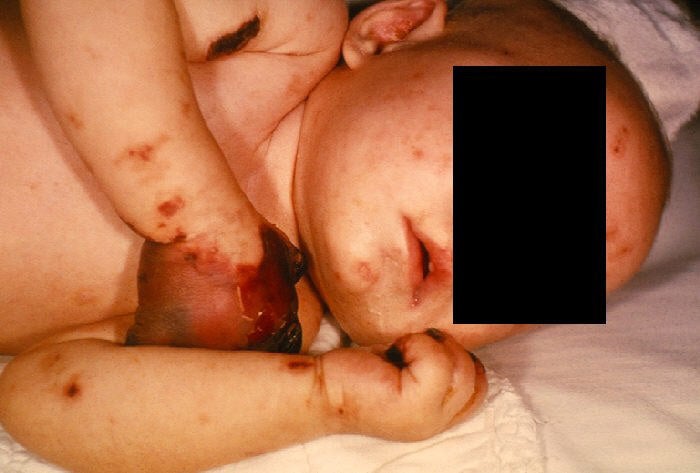
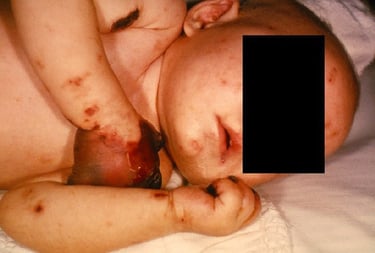
4 month old baby with gangrene of hands due to meningococcemia. Image reference on hyperlink on photo. Click on it to see more pictures (if you dare).






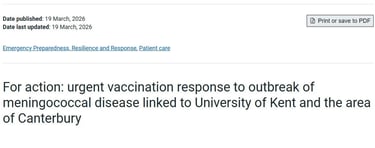


Bits and bobs to casually drop into conversation
Did you know....
There are 13 different types of the bacterium. Six of these - types A, B, C, W, X and Y - cause most of the disease cases worldwide.
The most common types in the UK are B, C, W and Y.
Since the MenC vaccine was introduced in the UK in 1999, there has been a big fall in MenC cases.
Most of the cases in the UK are currently caused by type B.
Since 2009, cases of MenW disease have been on the increase in the UK
Overall, 1 in 20 cases of meningococcal disease result in death. Death rates are higher for teenagers and young adults.
1 in 5 survivors have permanent effects such as skin scars, limb amputation(s), hearing loss, seizures and brain damage.
Between 5% and 11% of adults carry the bacteria in their throats asymptomatically. In teenagers this rate rises to 25%,
All visitors to the Hajj and Umrah pilgrimages in Saudi Arabia need proof that they have been vaccinated against type A, C, W and Y meningococcal disease - within the last 5 years.